HOME CANNING · JARS
Mason-type home-canning jars are engineered for repeated heat processing and two-piece self-sealing lids. The tested recipe—not the jar you happen to own—determines the safe jar size.
Choose jars made for home canning
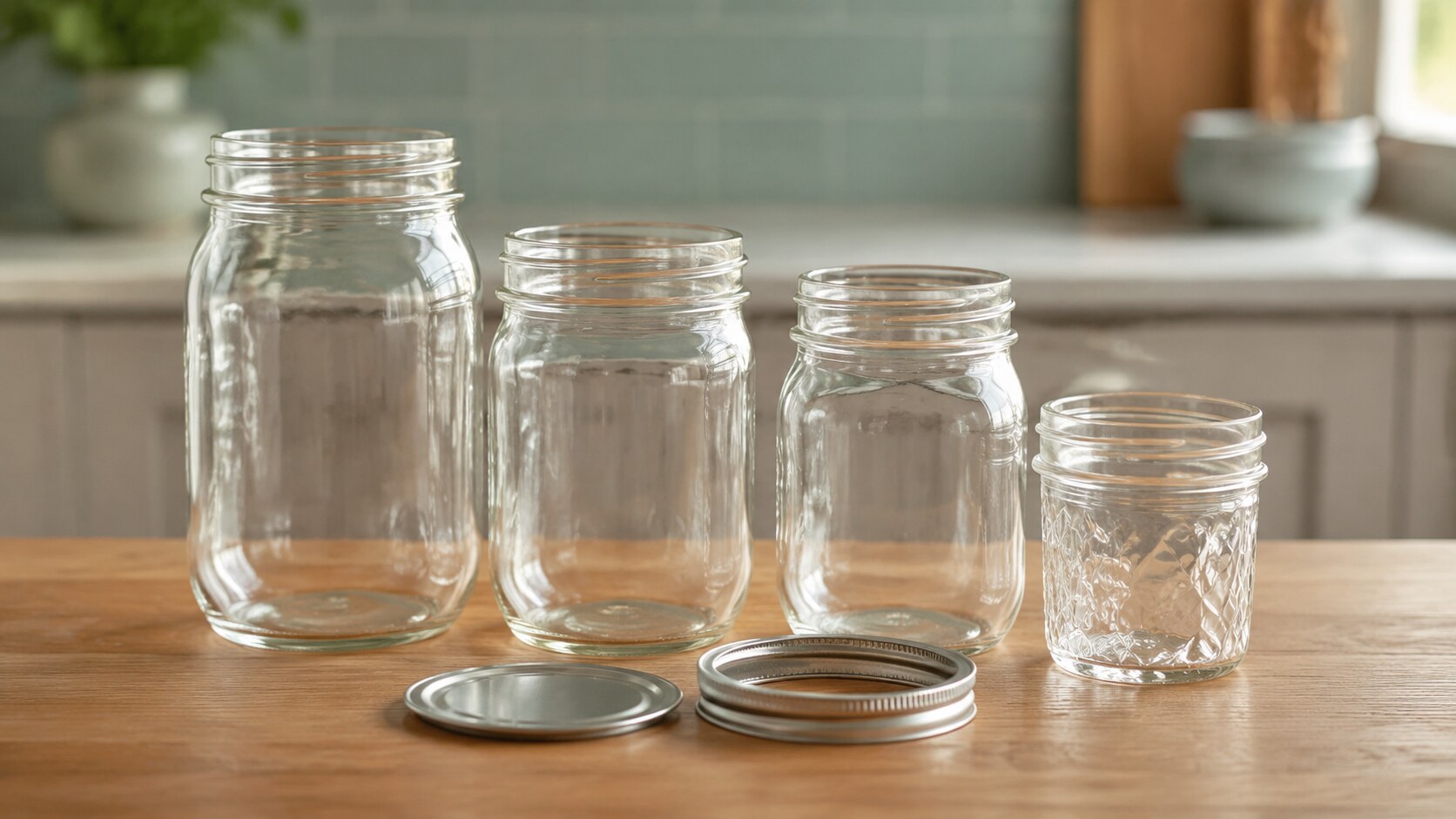
- Use regular- or wide-mouth Mason-type threaded home-canning jars with compatible self-sealing lids.
- Use only a jar size explicitly supported by the tested recipe. Never move up to a larger jar unless the source provides a process for it.
- Half-gallon jars have very limited tested uses, chiefly very acidic juices; do not treat them as general-purpose canning jars.
- Decorative jelly jars are suitable only when their size and closure match the tested recipe and lid system.
Inspect every jar
- Check the sealing rim for chips, nicks, roughness, and hairline cracks.
- Reject jars with damage, deep scratches, or weakened glass.
- Wash jars with detergent and rinse well before every use; a dishwasher cleans jars but does not by itself sterilize them.
- Keep jars at the temperature directed by the process to reduce thermal-shock breakage.
Reuse jars, not single-use lids
Sound Mason jars may be reused many times. Standard flat metal lids are intended for one canning use; use a new lid for each batch and follow the lid manufacturer’s current preparation instructions. Screw bands may be reused if clean, dry, unbent, and rust-free.
Commercial jars are not equivalent
Some commercial mayonnaise-type jars may fit two-piece lids, but they have a narrower sealing surface and higher risk of breakage or seal failure. NCHFP does not recommend them for pressure canning. Other commercial jars that cannot accept standard two-piece canning lids are not recommended for home canning.
Sources and further reading
Use a tested process
Use a current tested recipe from NCHFP, USDA, or a university Extension source. Follow its jar size, headspace, preparation method, process, time, pressure, and altitude adjustment exactly.