Before you begin, review Pressure Canning 101 for the complete method and safety fundamentals.
Yield: 9 pints or 7 quarts
Ingredients
- Average 13½ pounds beets without tops for 9 pints, or 21 pounds for 7 quarts
- One- to two-inch beets are preferred for whole packs; beets larger than 3 inches may be fibrous
- Canning salt is optional: up to ½ teaspoon per pint or 1 teaspoon per quart
Instructions
- Trim tops, leaving 1 inch of stem and roots to reduce color bleeding. Scrub well.
- Cover with boiling water and boil until skins slip easily, about 15–25 minutes depending on size.
- Cool only enough to handle, remove skins, stems, and roots, and keep the beets warm or hot.
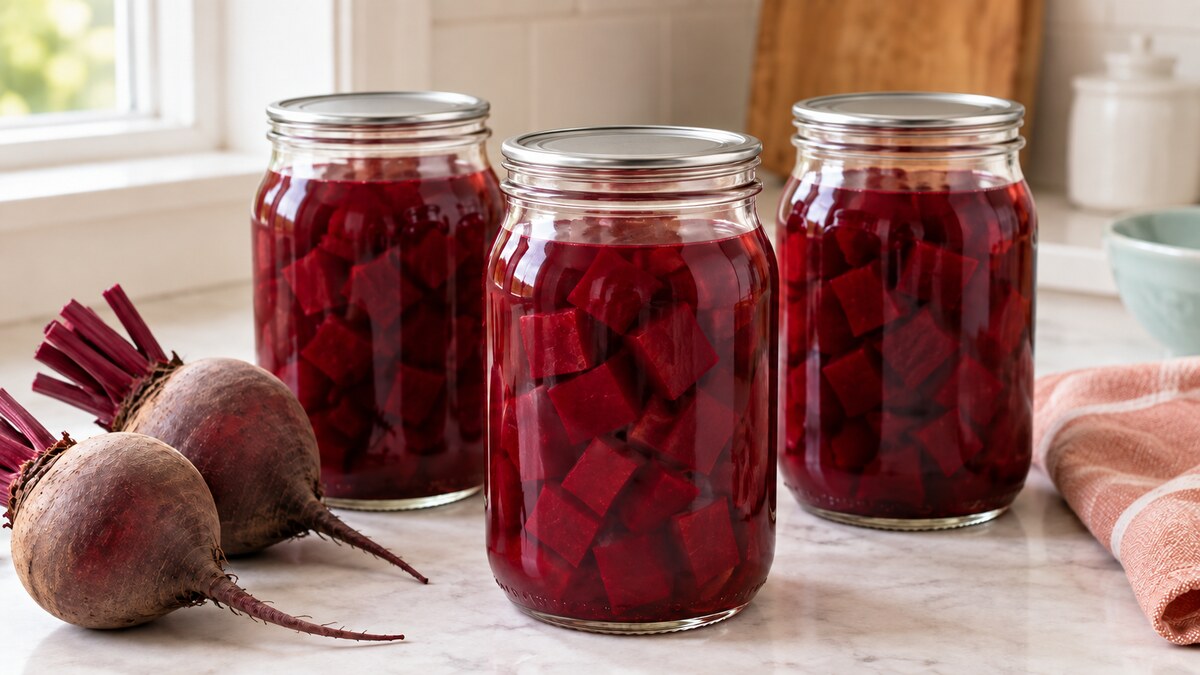
- Leave baby beets whole. Cut medium or large beets into ½-inch cubes or slices; halve or quarter very large slices.
- Fill jars with hot beets and fresh boiling water—not the beet-cooking water—leaving 1-inch headspace. Remove bubbles, recheck headspace, clean rims, and apply lids and bands.
Pressure-canning tables
Vent the canner for a full 10 minutes before pressurizing. Start timing only at the required pressure. If pressure drops below the requirement, return to pressure and restart the full processing time.
Dial-gauge canner
| Jar size | Time | 0–2,000 ft | 2,001–4,000 ft | 4,001–6,000 ft | 6,001–8,000 ft |
|---|---|---|---|---|---|
| Pints | 30 min | 11 lb | 12 lb | 13 lb | 14 lb |
| Quarts | 35 min | 11 lb | 12 lb | 13 lb | 14 lb |
Weighted-gauge canner
| Jar size | Time | 0–1,000 ft | Above 1,000 ft |
|---|---|---|---|
| Pints | 30 min | 10 lb | 15 lb |
| Quarts | 35 min | 10 lb | 15 lb |
Notes
Cool, check, and store:
• Allow the canner to depressurize naturally; never force-cool it.
• After full depressurization, remove the weight or open the petcock, wait 10 minutes, then open the lid away from your face.
• Cool jars upright and undisturbed for 12–24 hours.
• Test seals, remove bands, wash, label, and store in a cool, dark, dry place.
• Refrigerate unsealed jars promptly. Do not taste food from a jar showing spoilage.
Always follow the current linked source and your equipment manufacturer’s instructions.
Tested source: National Center for Home Food Preservation tested procedure