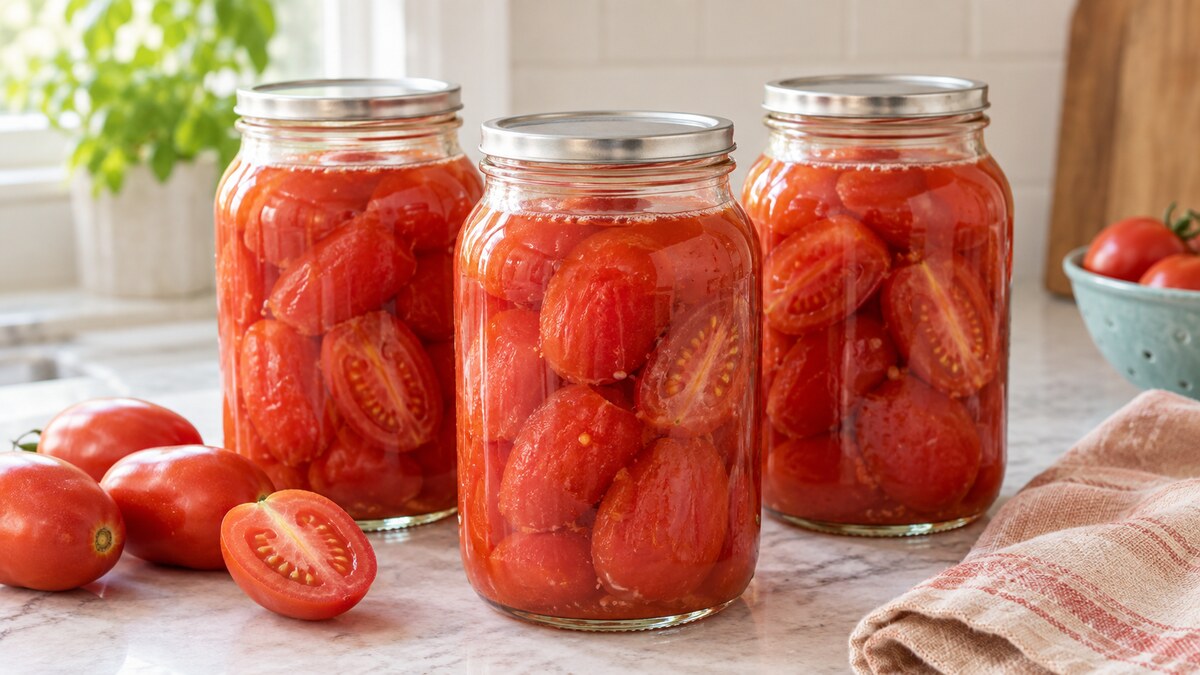
Before you begin, review Water-Bath Canning 101 for the complete method and safety fundamentals.
Yield: 9 pints or 7 quarts
Ingredients
- Average 13 pounds tomatoes for a canner load of 9 pints, or 21 pounds for 7 quarts
- Bottled lemon juice or citric acid in the exact amount below
- Boiling water for packing
- Canning salt, optional: up to ½ teaspoon per pint or 1 teaspoon per quart
Instructions
- Wash tomatoes. Dip in boiling water for 30–60 seconds or until skins split, then cool in cold water.
- Slip off skins, remove cores, and leave tomatoes whole or halve them.
- For raw pack, place prepared raw tomatoes in hot jars and cover with boiling water. For hot pack, cover prepared tomatoes with water in a saucepan, boil gently 5 minutes, then fill hot jars with hot tomatoes and cooking liquid.
- Leave ½-inch headspace. Remove bubbles, recheck headspace, clean rims, and apply lids and bands according to current manufacturer instructions.
Boiling-water processing time
Add acid directly to every jar before filling. For each pint, use 1 tablespoon bottled lemon juice or ¼ teaspoon citric acid. For each quart, use 2 tablespoons bottled lemon juice or ½ teaspoon citric acid. Sugar may be added to soften the tart flavor; do not reduce or omit the acid.
| Jar size | 0–1,000 ft | 1,001–3,000 ft | 3,001–6,000 ft | Above 6,000 ft |
|---|---|---|---|---|
| Pints | 40 min | 45 min | 50 min | 55 min |
| Quarts | 45 min | 50 min | 55 min | 60 min |
Notes
Cool, check, and store:
• After processing, follow the canner procedure for removing the jars.
• Cool jars upright and undisturbed for 12–24 hours on folded towels, leaving at least 1 inch between jars. Avoid cold or wet surfaces and cold drafts.
• After cooling, remove bands, test seals, wash jars and lids, label, and store in a cool, dark, dry place.
• Refrigerate any unsealed jar promptly. Do not taste food from a jar showing spoilage.
Always follow the current linked source and your equipment manufacturer’s instructions.
Tested source: National Center for Home Food Preservation tested procedure